
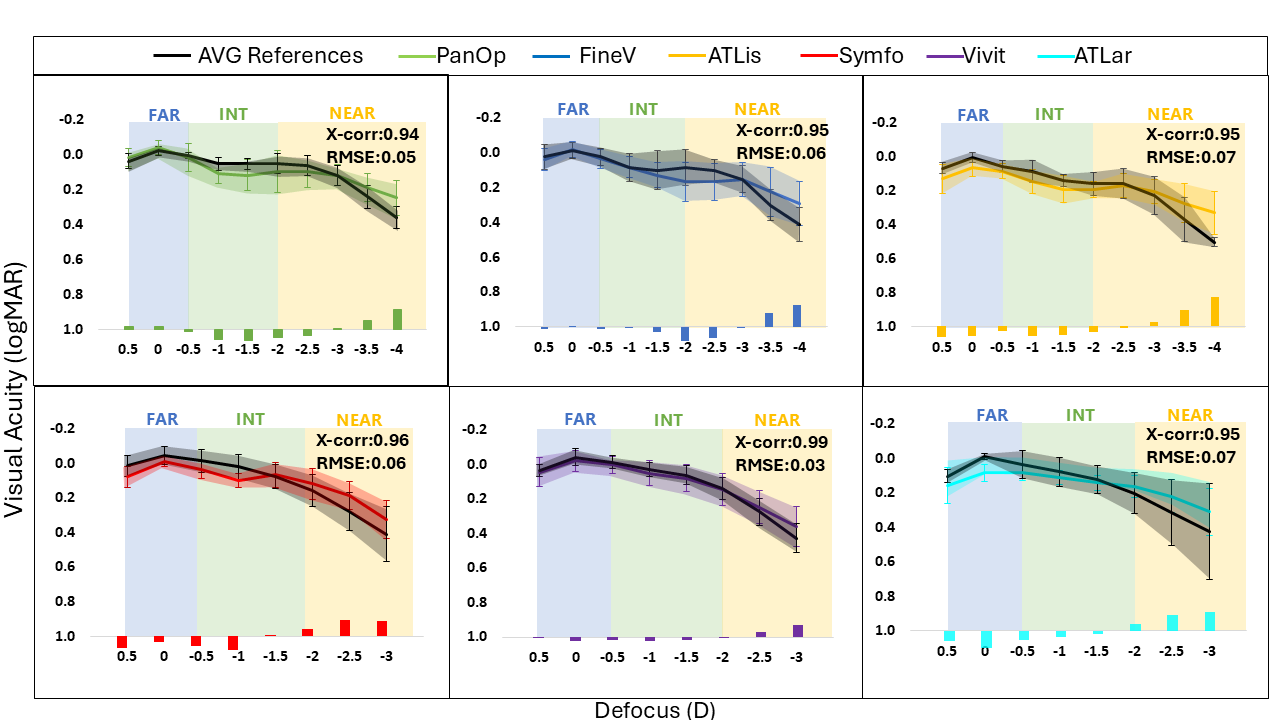
Purpose: To validate whether visual simulations of multifocal intraocular lenses and extended depth of focus (EDOF) intraocular lenses (IOLs) in phakic presbyopes replicate postoperative vision, and to compare performance across these lenses in the same subject.
Methods: Twenty-three presbyopes with clear crystalline lenses were evaluated binocularly using SimVis Gekko visual simulator (2EyesVision).Six commercial multifocal and EDOF IOLs were simulated using the principle of temporal multiplexing: AcrySoft IQ PanOptix, FineVision POD F, AT Lisa tri, Tecnis Symfony, AcrySoft IQ Vivity, and AT Lara. Defocus visual acuity (DFVA) curves were measured for each simulated IOL under photopic conditions. Simulated IOLs were programmed from published through-focus modulation transfer function data at 15 cycles/degree. Defocus visual acuity curves through simulated IOLs were compared to average postoperative DFVA data from peer-reviewed publications (108–322 pseudophakic patients per IOL).
Results: Simulated IOLs accurately reproduced on-bench optical profiles in terms of through-focus Visual Strehl Ratio (cross-correlation >0.98, RMSE <0.04). Defocus visual acuity curves through simulated IOLs closely matched postoperative curves in subjects implanted with the corresponding IOL (cross-correlation ≥0.94, RMSE ≤0.07), with far vision differences ≤0.09 logarithm of the minimum angle of resolution (logMAR). Discrepancies were largest at high near vergences (up to 0.17 logMAR). Trifocal IOLs (PanOptix, FineVision, AT Lisa) expanded DOF by ∼1.5 D compared with monofocal IOLs, while EDOF IOLs (Symfony, Vivity, AT Lara) expanded DOF by ∼0.7 D. Visual simulations replicated relative gains at intermediate/near and degradations at far, consistent with clinical outcomes in implanted patients. Intersubject variability observed in simulations