

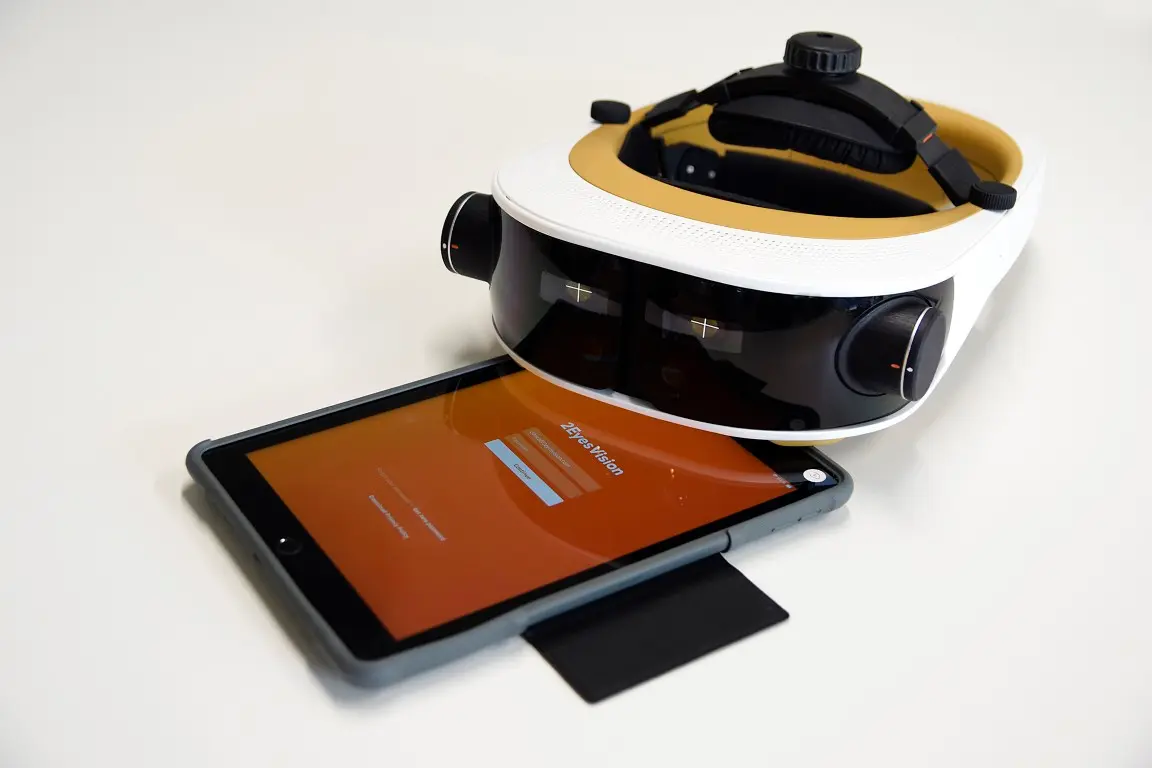
A new approach to experiencing visual outcomes before cataract and presbyopia surgery
Choosing an intraocular lens (IOL) is one of the most important decisions in cataract and refractive lens surgery. While biometric calculations predict refractive accuracy, they do not fully capture how a patient will perceive visual quality in daily life. Uncertainty about halos, depth of focus and spectacle independence often generates anxiety before surgery. SimVis Gekko is an optical simulation technology designed to allow patients to experience potential visual outcomes before implantation, supporting better-informed decisions and improved expectation alignment.
What is SimVis Gekko?
SimVis Gekko is a wearable, binocular visual simulator designed to allow patients and eye care professionals to experience and evaluate different visual outcomes before cataract or refractive surgery. Using advanced optical technology, it recreates how various intraocular lenses (IOLs)—such as monofocal, multifocal, or extended depth of focus (EDOF)—will perform in real-life conditions. The device is mounted on the patient’s head and enables dynamic, real-time simulation of vision, allowing users to look at their surroundings naturally while comparing different lens options. Unlike theoretical explanations or static images, SimVis Gekko provides an immersive and personalized visual experience. Patients can directly perceive key aspects such as near and distance vision, contrast, halos, and overall visual quality. This helps them better understand the trade-offs associated with each lens type and make more informed decisions. For clinicians, SimVis Gekko is a powerful tool to improve communication, manage expectations, and optimize patient selection. By aligning what patients expect with what they will actually experience after surgery, it contributes to higher satisfaction rates and more predictable refractive outcomes.
Why was SimVis Gekko developed?
Modern cataract surgery has become refractive in nature. Patients increasingly ask:
- Will I still need glasses?
- Will I see halos?
- Can I know how I will see before surgery?
Traditional explanation may not fully address these concerns. As highlighted by the American Academy of Ophthalmology, expectation management plays a central role in patient satisfaction. SimVis Gekko was developed to bridge the gap between explanation and perception.
How does SimVis Gekko work?
SimVis Gekko2 uses controlled optical modulation to reproduce visual effects associated with different intraocular lens designs. It does not implant or test a physical lens. Instead, it:
- Modifies light patterns entering the eye
- Simulates depth-of-focus characteristics
- Demonstrates potential photic phenomena
The goal is not to guarantee an exact postoperative result, but to provide realistic experiential insight before a permanent decision is made.
Who can benefit from SimVis Gekko?
SimVis Gekko2 may be particularly valuable for:
- Patients considering multifocal or EDOF lenses
- Individuals concerned about night vision quality
- Patients unsure about reducing glasses
- Clinics focused on premium differentiation
It supports shared decision-making by making visual trade-offs tangible.
Does SimVis Gekko replace surgical planning?
No. SimVis Gekko complements biometric calculations and clinical evaluation.
Biometry predicts refractive power.
Simulation addresses perception and expectation.
Both are part of comprehensive pre-surgical planning.
Is the simulation result guaranteed?
No visual simulation system can perfectly predict subjective perception after surgery. Visual outcome depends on:
- Ocular health
- Neural adaptation
- Individual sensitivity
- Residual refractive factors
However, experiential insight reduces uncertainty and improves decision confidence.
Why expectation alignment matters
Research published in leading ophthalmology journals consistently shows that postoperative dissatisfaction is often related to expectation mismatch rather than surgical inaccuracy. Professor David F. Chang has emphasized that meeting expectations is central to satisfaction in refractive cataract surgery. Technologies that support expectation alignment contribute to better overall patient experience.