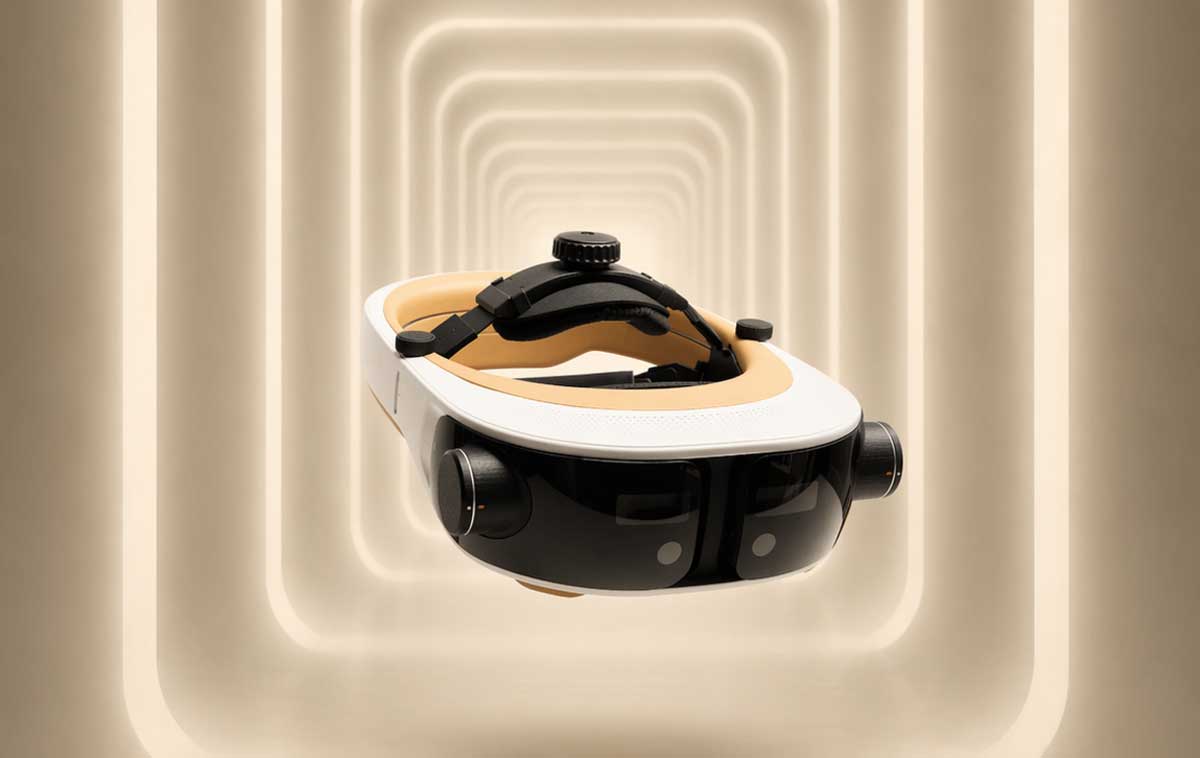
Recognized at ASCRS, the award-winning study published in The Journal of Cataract & Refractive Surgery highlights a paradigm shift from traditional ocular dominance tests to sensory-based assessment using real-world visual simulation with SimVis Gekko
Washington DC, USA — The peer-reviewed study “Assessing ocular dominance: rethinking the current paradigm”—featuring the SimVis Gekko visual simulator—has been awarded the 2025 Seth J. Obstbaum Award for Best Original Research Article by The Journal of Cataract & Refractive Surgery, presented at ASCRS. The recognition highlights a growing shift in ophthalmology: moving from traditional, assumption-based methods toward experience-driven clinical decision-making.
“This recognition reinforces a fundamental shift in ophthalmology—from estimating visual outcomes to actually experiencing them before surgery,” said Carlos Dorronsoro, CEO of 2EyesVision.
A critical gap in traditional ocular dominance assessment
The study evaluated ocular dominance using a novel sensory approach—Eye Dominance Strength (EDS)—measured through a head-mounted, binocular visual simulator, and compared it with the widely used hole-in-the-card sighting test. Results revealed a significant discrepancy between both methods:
- In 41% of cases, traditional sighting dominance did not match sensory dominance
- The study included 326 participants across five private practices in the United States
- For the first time, clinicians can assess not only which eye dominates, but also how strongly it does
“What matters in clinical practice is not which eye a test selects, but how the patient actually perceives vision under real conditions,” added Dorronsoro.
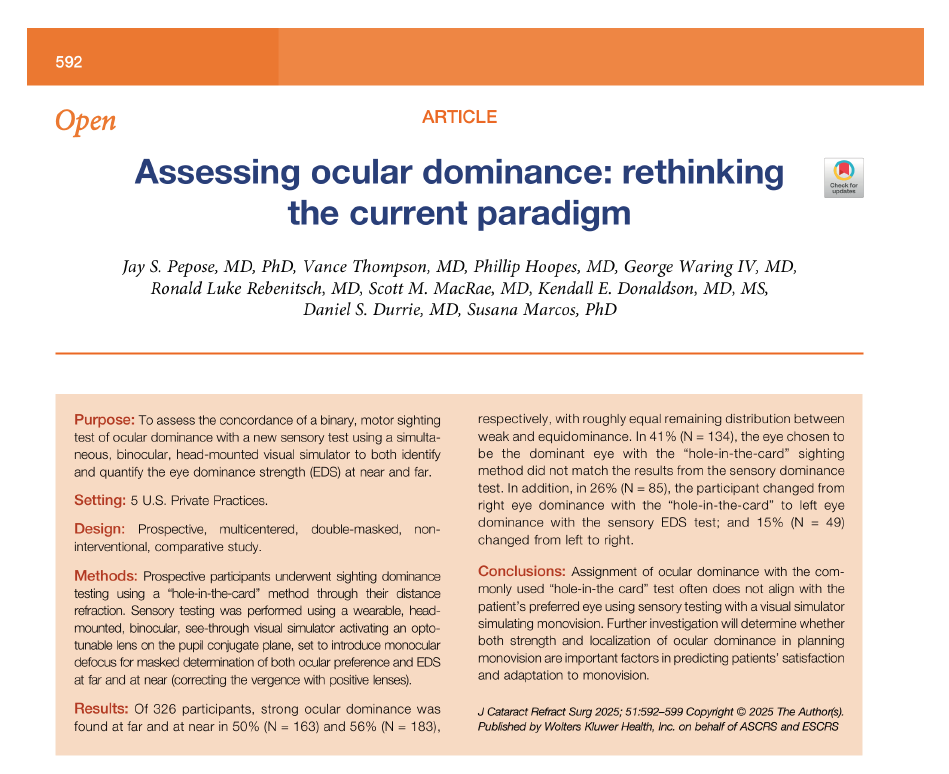
Study extract published in the Journal of Cataract & Refractive Surgery (JCRS).
From assumption to simulation
These findings challenge a long-standing clinical paradigm in ophthalmology. Traditional dominance tests rely on motor preference and may not reflect the functional visual experience that determines patient satisfaction in procedures such as monovision correction. In contrast, visual simulation enables patients to experience outcomes before surgery, bringing clinical decisions closer to real-world perception.
“We are moving from assumptions to real visual experience. This is key to improving both clinical decision-making and patient confidence,” said Dorronsoro.
Improving outcomes in monovision workflows
For cataract and refractive surgeons, the integration of sensory dominance and visual simulation represents a more precise and patient-centered approach to monovision planning. By incorporating real-time simulation:
- Patient selection can be refined
- Visual outcomes become more predictable
- Patient satisfaction may significantly improve
Ultimately, this approach aligns clinical decisions with how patients will actually see—not how clinicians assume they will see.
“When patients can experience their vision before surgery, conversations change. Decisions become clearer, and outcomes are better aligned with expectations,” concluded Dorronsoro.
About the Seth J. Obstbaum Award
The Seth J. Obstbaum Award, presented annually at the American Society of Cataract and Refractive Surgery (ASCRS), honors the most outstanding original research article published in the Journal of Cataract & Refractive Surgery during the previous year. It is considered one of the most prestigious recognitions in ophthalmology, highlighting scientific excellence and innovation that significantly advances the field.